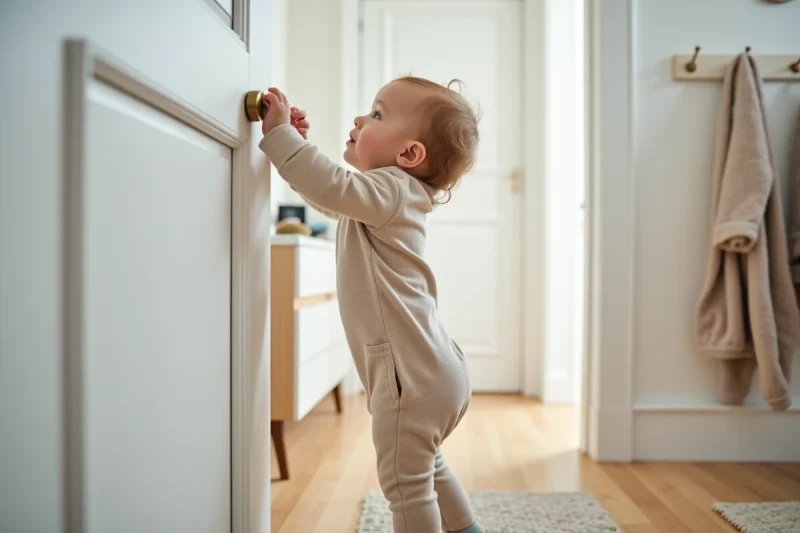
The ability of a toddler to operate a door handle depends on several factors: grip strength, size, hand-wrist coordination, and the type of mechanism. Classic developmental milestones place this skill acquisition around 24 months, with an average observed closer to 28 to 30 months for round handles. These ranges mask considerable variations from one child to another.
Fine motor skills and wrist rotation: often underestimated motor prerequisites
Opening a door is not just about pulling or pushing. The action requires coordination between the palmar grip (grasping the handle), wrist rotation (turning the mechanism), and body weight transfer (pulling or pushing the door). These three simultaneous actions mobilize fine motor skills that gradually develop from around 12 months, when the child begins to manipulate objects with precision.
Wrist rotation, in particular, develops through everyday gestures: screwing on a cap, turning the pages of a board book, using a spoon. A child regularly exposed to these grasping activities develops the strength and flexibility needed to operate a door mechanism earlier.
Parents wondering at what age babies open doors rarely receive a single answer, because the type of handle radically changes the difficulty of the action. A lever handle lowers with the weight of the hand, while a round handle requires a firm grip and controlled rotational movement.

Variations in early development: size, environment, and Montessori stimulation
According to feedback from Montessori nurseries, children exposed to fine motor activities as early as 12 months master round handles by around 20 months, compared to 28 to 30 months in a standard environment. This significant gap is explained by the daily repetition of targeted gestures: key locks, shape sorting boxes, practice locks.
The child’s size also plays a direct role. Pediatric observations indicate that children above the 95th percentile in height reach handles as early as 15 to 16 months, well before the typically described window. For these profiles, safety adaptations should be anticipated several months in advance.
Signals that precede door opening
Before successfully opening, the child goes through observable stages:
- They hang from the handle without being able to turn it, using their weight as leverage, usually around 14 to 18 months.
- They partially turn the handle but do not yet coordinate the pulling or pushing movement of the door.
- They observe an adult or older sibling operate the door and replicate the entire sequence, sometimes in just a few attempts.
These stages span several weeks, or even months. The transition from observation to success can also occur suddenly, without any obvious warning signs.
Adaptive Montessori setup: securing without hindering exploration
The Montessori approach is based on a clear principle: adapt the environment to the child rather than restrict their movements. Applied to doors, this principle requires distinguishing between areas to secure (stairs, kitchen, outdoors) and areas where autonomy can be encouraged (bedroom, playroom).
For accessible rooms, installing lever handles at child height (between 60 and 80 cm) allows a toddler to move freely as soon as they master standing. This type of setup respects their need for exploration while developing their motor skills.
Securing risky areas without total locking
For dangerous rooms, several devices exist, but not all are equally effective or respectful of autonomy:
- Invisible magnetic wedges: fixed at the top of the frame, they open with a magnet that only the adult possesses. The child does not perceive a mechanism to force, which reduces frustration.
- Double-action handle locks: they require two simultaneous actions (pressing and turning), a sequence too complex for a child under 30 months.
- Low safety barriers with a gate: they visually delineate the forbidden space while remaining passable for adults.
The European directive 2025/347 has mandated since 2026 a minimum height of 1.20 m for door handles in establishments welcoming children, aiming to delay autonomous access until 24-30 months without compromising accessibility for people with reduced mobility. This standard does not apply to private homes, but it provides a useful benchmark for parents wishing to reposition certain handles.
Motor development and doors: supporting rather than blocking
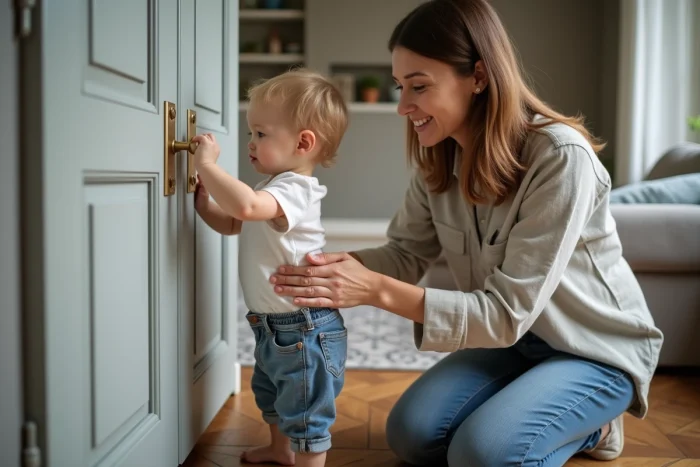
A child who begins to manipulate handles expresses a need to master their environment. Systematically blocking all access can generate frustration and lead to more dangerous climbing behaviors than opening a door itself.
The most coherent approach is to leave two or three doors accessible in the house and secure only critical access points. This way, the child develops their coordination, motor confidence, and understanding of space while remaining protected from real risks.
Montessori practical life activities (practice locks, turn locks, manipulable padlocks) offer a parallel learning channel. They allow the child to repeat the rotational gesture in a secure setting, without the stakes of escape or danger. These fine motor games also prepare for other skills: holding a pencil, buttoning clothing, using scissors.
The 24-month milestone remains an average, not a universal threshold. A stimulated child, tall for their age, or one with older siblings to imitate may master handles much earlier. Observing the child’s behavior with doors, rather than adhering to a rigid timeline, remains the best guide for deciding when and how to adapt the home environment.