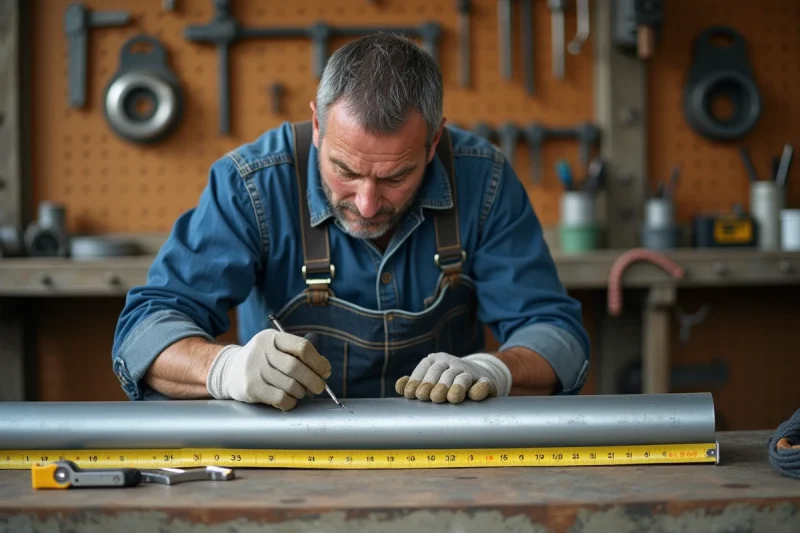
Cutting a zinc downspout involves sectioning a cylindrical tube made of soft metal, with thickness varying by manufacturer, without deforming the section or creating burrs that would prevent the elements from fitting together. Zinc does not react well to harsh mechanical stresses: a poor tool or too much pressure can crush the tube, distort the roundness, and compromise the seal of the joint.
The difficulty lies not in the hardness of the metal, but in its malleability. A zinc tube deforms before it cuts if the pressure is unevenly distributed.
Risk of galvanic corrosion during cutting and joining
Before even choosing a tool, it is essential to check the metallic environment of the downspout. The electrolytic couple between different metals accelerates the degradation of zinc when two metals are on the same path for rainwater drainage. An untreated steel blade that leaves particles in the cut, a copper fixing collar, or a junction with an aluminum elbow is enough to initiate premature corrosion.
Knowing how to cut a zinc downspout also involves choosing compatible accessories: zinc or stainless steel collars, rivets of the same metal, and neutral electrochemically mastic for the joints.
This point is systematically ignored in DIY tutorials, even though it conditions the lifespan of the entire drainage network.
Cutting tools suitable for zinc downspouts
Not all tools capable of cutting metal are suitable for zinc. The determining criterion is the ability to section the tube without crushing the circular section.
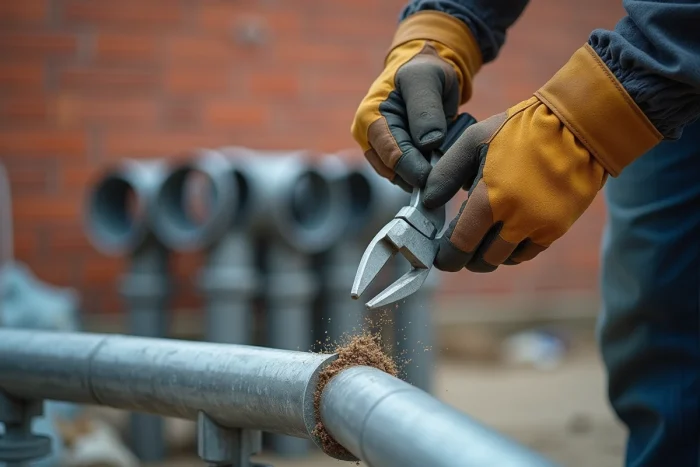
Sheet metal nibblers
The nibbler cuts zinc by progressive nibbling, without lateral deformation. It produces a fine line and leaves the edges relatively smooth. It is the reference tool for roofers and zinc workers for downspout tubes.
Its disadvantage: it projects small metal chips. Gloves and goggles must be worn, and the residues inside the tube should be cleaned after cutting to avoid any blockage.
Fine-toothed hacksaw
A hacksaw with a fine-toothed blade works well as long as the tube is kept still. The main risk is ovalization: if the tube moves during sawing, the section becomes oval and no longer fits into the joint.
To limit this risk, secure the tube in a vise with protective jaws (interpose cardboard or fabric between the jaws and the zinc) or hold it with a clamp on a stable surface.
Angle grinder: a false friend
The angle grinder is not recommended for zinc downspouts. The rotational speed generates localized heat that alters the protective patina layer of the zinc. Sparks can also damage the facade. The cut may seem quick, but it weakens the metal over several centimeters around the line.
- Sheet metal nibblers: clean cut, no deformation, ideal for cylindrical tubes
- Hacksaw (fine-toothed): effective if the tube is perfectly immobilized, moderate risk of ovalization
- Straight tin snips: usable on the flat parts of a tube already split, but not for initiating a complete circular cut
- Angle grinder: to be avoided, alters the surface of the zinc and compromises its corrosion resistance
Expansion of zinc and cutting length
Zinc expands and contracts significantly with temperature changes. Professional rules require the provision of expansion joints suitable for the length of the elements, including on downspouts.
In practice, this means that a downspout cut too short in winter will be too short in summer, and vice versa. When taking measurements, it is necessary to include an overlap margin between the fitted sections. This margin absorbs dimensional variations without creating tension on the fixing collars.
Cutting the downspout to the exact measured length in millimeters is a common mistake. Providing sufficient overlap between fitted sections absorbs expansion.
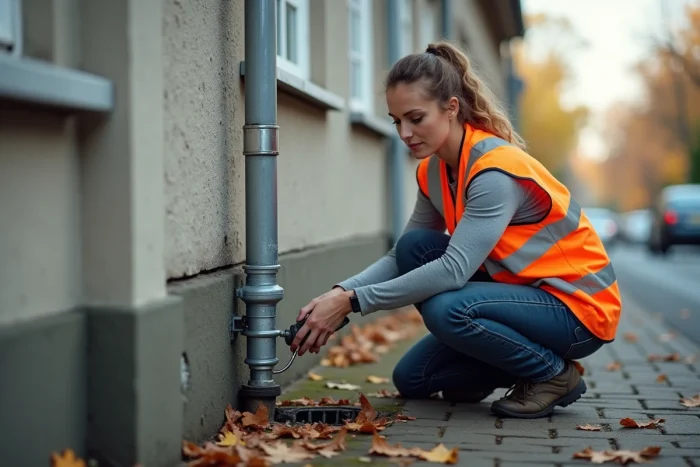
Finishing the cut line on a zinc downspout
A rough cut, even when made with the right tool, leaves burrs on the inner edge of the tube. These burrs pose two concrete problems.
The first: they hinder the flow of water and trap plant debris, which promotes blockages. The second: they prevent the correct fitting of the next section, creating a gap where water can seep in.
Deburring and calibrating
After cutting, run a soft file or fine-grit sandpaper around the entire inner and outer perimeter of the tube. The goal is to achieve a smooth edge to the touch, without any roughness that could catch a nail.
If the cut has slightly ovalized the tube, a conical mandrel (or simply a round tool handle of the right diameter) can be used to recalibrate the section by gently forcing the inside of the tube back to its original shape.
- File the inner and outer burrs around the entire perimeter of the cut
- Check the dry fitting before securing the tube, to detect any rounding defects
- Clean the inside of the tube to remove residual metal chips, which would accelerate local oxidation
Ventilation and installation context
Recent technical sources remind us that the durability of a zinc downspout also depends on the ventilation of the entire roof. Poorly ventilated zinc undergoes finishing degradation, even if the cutting and joining are impeccable.
When working on a downspout, check that the space between the tube and the facade wall allows for minimal air circulation. A tube pressed against a damp wall degrades faster than a tube spaced a few centimeters away.
Cutting a zinc downspout remains a simple operation as long as three often underestimated constraints are respected: the metallic compatibility of the contacting elements, the choice of a tool that does not deform the section, and the expansion margin integrated from the measurement. A clean cut line is useless if the tube is crushed or if the joint corrodes the zinc within a few seasons.