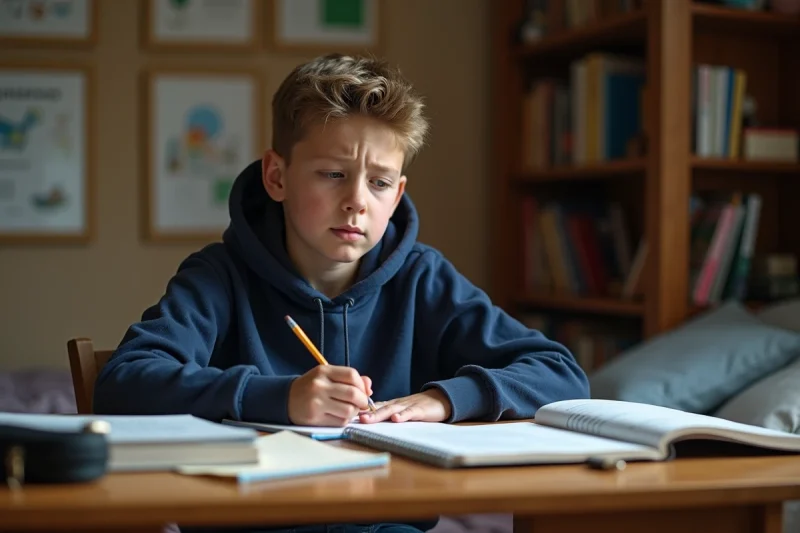
In middle school, academic difficulty takes various forms: gradual dropout, diagnosed or undiagnosed learning disorders, loss of confidence in the face of a more demanding pace. Institutional support systems exist, but their effectiveness largely depends on how they are utilized daily, both in class and at home.
Active memorization in middle school: what cognitive sciences concretely change
Rereading a lesson multiple times remains the most common method among middle school students. However, research in cognitive sciences shared by the Academy of Versailles shows that asking questions about the lesson is more effective than rereading it. This technique, called self-questioning, is based on a simple principle: forcing the brain to retrieve information rather than passively reviewing it.
In practice, this involves concrete tools. Flashcards (double-sided memory cards), memo sheets to hide and then reveal, or alternating between questions and answers are suitable supports for struggling students. Some teachers now dedicate entire sessions at the beginning of the year to the explicit teaching of these techniques.
Spaced training complements this approach. Instead of reviewing a lesson the night before a test, the student revisits the same concept at increasing intervals. For a school for students with academic difficulties, this method reduces cognitive overload and helps consolidate learning over time.

Digital tools for dyslexic students: regular accommodations, not one-off gadgets
Digital tools designed for students with dys disorders (dyslexia, dyspraxia, dyscalculia) have moved beyond the experimental stage in many institutions. Their use is no longer limited to a text-to-speech software installed on a borrowed computer.
Several types of accommodations have been structured around digital tools:
- Audio instructions allow a dyslexic student to receive the statement of an exercise without relying solely on written text, reducing fatigue related to decoding.
- Interactive quizzes on tablets offer an assessment format where the student can focus on reasoning rather than writing, which is often penalizing for dys profiles.
- Increased time during digital assessments can be configured directly in the tool, without requiring negotiation for each test.
These systems function as regular learning and assessment accommodations, integrated into an inclusive school logic. The nuance is crucial: a tool used once a quarter does not produce the same effects as structured daily use.
Observed limitations in the field
Field feedback diverges on one specific point: teacher support. A poorly configured reading software or a tablet without appropriate content solves nothing. The digital tool only has an effect if the teacher knows how to integrate it into their pedagogical progression. Institutions that train their teams in advance achieve more consistent results than those that merely distribute equipment.
Institutional support systems in middle school: what exists and what is lacking
The regulatory framework provides several forms of assistance for struggling middle school students. Personalized support, bridge programs for students at risk of dropping out, and orientation programs like the Parcours Avenir are part of the available arsenal.
Personalized support, integrated into the timetable, aims to work on methods, understanding, and organization. However, its implementation varies greatly from one institution to another. In some middle schools, it is reduced to homework help supervised by a monitor. In others, it takes the form of structured sessions with a specific educational objective.
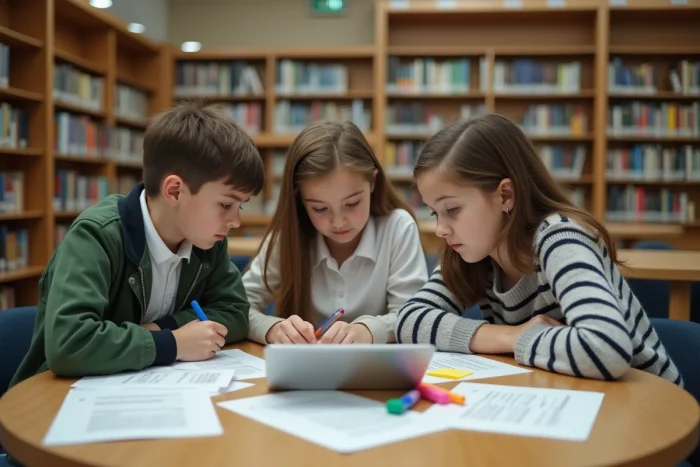
Bridge programs accommodate students in advanced dropout situations, often after several reports. They offer a reduced framework, with enhanced supervision, for a limited duration. The goal is to return to regular classes, not a permanent parallel track.
The role of the personalized educational success project
The PPRE (personalized educational success project) formalizes the assistance provided to a student over a given period. It identifies the skills to strengthen, the resources mobilized, and the criteria for evaluating progress. Its strength lies in the coordination it imposes between the educational team and the family.
Its weakness often lies in its follow-up. A PPRE written in October and never reevaluated before June loses much of its usefulness. The regularity of interim assessments conditions the effectiveness of the system.
Building academic autonomy: a learning process that is not self-evident
In middle school, academic difficulty is often linked to a lack of method rather than a lack of ability. The transition from primary to secondary school imposes skills that many students have never explicitly acquired: organizing their time, prioritizing tasks, preparing for an assessment over several days.
Some institutions integrate sessions dedicated to methodology as early as sixth grade. These sessions cover specific points:
- Learning to read and understand an instruction before starting an exercise, identifying action verbs (describe, explain, compare).
- Building a realistic revision schedule, with short and regular slots rather than a long session the night before.
- Keeping a notebook or agenda functionally, distinguishing what needs to be done from what needs to be remembered.
These skills are not acquired through a general discourse on organization. They are worked on in context, using concrete examples drawn from ongoing lessons. A student who knows how to break down a complex task into steps gains autonomy and confidence.
Success in middle school for a struggling student rarely relies on a single lever. The interplay between suitable tools, a mobilized institutional framework, and explicit work on learning methods produces more lasting effects than an isolated response. Families that identify their child’s specific needs early and engage in regular dialogue with the educational team have a concrete advantage in supporting this pivotal period.