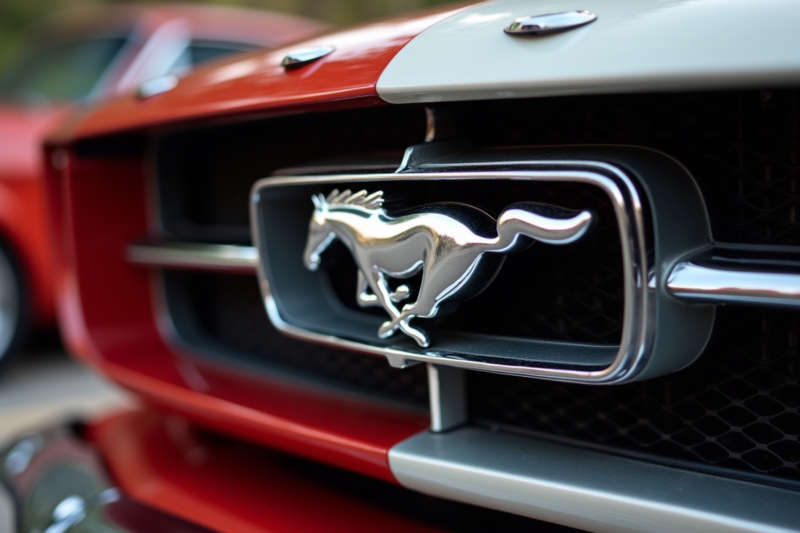
Automotive emblems are not just logos; they embody the essence of each manufacturer. At Ford, the blue oval is much more than a geometric shape. This symbol distills the heritage of a brand that has revolutionized the automotive industry.
Since the creation of the first Model T in 1908, Ford has successfully blended innovation and tradition. The blue oval has become a globally recognized icon, representing reliability and ingenuity. Behind this sleek design lies a subtle art, the result of decades of corporate culture and aesthetic refinement.
The historical and cultural inspirations behind the Ford emblem
The blue oval of Ford, an emblematic symbol of the American automotive industry, has its roots in a rich and complex history. Designed by Childe Harold Wills, a close collaborator of Henry Ford, this emblem reflects the vision of its creator for a brand focused on simplicity and reliability.
Childe Harold Wills designed the first Ford logo in 1907. Inspired by the elegant typography of the Victorian era, Wills opted for distinctive calligraphy, marking a break from the more austere industrial logos of his contemporaries. This artistic eye allowed the Ford Logotype to acquire a unique and easily recognizable visual identity.
- The blue oval emphasizes simplicity and reliability.
- The sleek design is the result of decades of aesthetic refinement.
The choice of the blue oval is not trivial. It symbolizes robustness and consistency, essential values during a time marked by economic uncertainties and rapid technological advancements. Amid the industrial revolution, Ford managed to embody modernity while staying true to principles of quality and durability. This duality between tradition and innovation is at the very heart of Ford’s identity, an aspect detailed in ‘Ford Logotype’.
Throughout the ages, the Ford logo has adapted while maintaining its essence. From World War I to World War II, through economic crises and periods of prosperity, the blue oval has remained a stable visual landmark. It has become an undisputed emblem of the American automotive industry, carried by iconic models like the Ford Mustang and the Ford Mustang Shelby. 
The impact of the Ford emblem on brand identity and perception
The blue oval of Ford, beyond its aesthetic role, has profoundly influenced the perception of the brand over the decades. This emblem, a symbol of simplicity and reliability, has managed to embody a strong and coherent identity, essential for a company navigating a sector as competitive as the automotive industry.
The impact on identity: the blue oval is not just a logo, but a true marker of identity. It reinforces Ford’s image as a manufacturer of robust and accessible vehicles. This visual identity has helped forge a trust relationship with consumers, assuring them that every model bearing this emblem meets high standards of quality and durability.
- Simplicity: The blue oval evokes a clean aesthetic, in line with the brand’s values of efficiency and functionality.
- Reliability: This emblem guarantees customers a certain consistency and robustness, key attributes for retaining a demanding clientele.
Brand perception: the Ford emblem plays a fundamental role in how the brand is perceived internationally. By displaying this oval, each vehicle positions itself as a symbol of American industrial ingenuity. Iconic models, such as the Ford Mustang, thus benefit from a particular aura, enhanced by the history and tradition embodied by this emblem.
The presence of the blue oval on Ford vehicles is a declaration of trust in the brand. It establishes a visual and emotional continuity between generations of customers, while remaining a reassuring landmark in a constantly evolving market. This consistency has allowed Ford to stand out and maintain a leading position in the global automotive industry.