
Comparing flight tickets for a family of four often takes more time than choosing the destination itself. Between assigned seating fees, baggage surcharges, and meal options, the final price of a family flight can double compared to the advertised fare. Traveling with children as a family means mastering these hidden costs even before finalizing an itinerary.
The real cost of a family flight: how surcharges change things
The European Parliament approved, on July 7, 2026, a revision of air passenger rights. The text stipulates that a child under 14 years old must sit next to an accompanying adult at no extra charge. The reform still needs to come into effect after official publication and an adjustment period for airlines.
This same framework requires airlines and intermediaries to present baggage fees and travel options more clearly from the start of the booking process. For families, this will facilitate the comparison between tickets that seem cheap but become more expensive after adding services.
| Expense Item | Before Reform | After Reform (Expected) |
|---|---|---|
| Child seat next to an adult | Surcharge charged by most low-cost airlines | Free for under 14s |
| Price Transparency (baggage, options) | Fees often displayed during the booking process | Mandatory display from the start of the purchasing journey |
| Personal baggage (under the seat) | Generally included | Guaranteed free by the text |
| Cabin suitcase (overhead compartment) | Chargeable depending on the airline | Still chargeable, no change |
The distinction between free personal baggage and chargeable cabin suitcases is often misunderstood. The adopted text guarantees an item that can be placed under the seat, but airlines retain the option to charge for larger cabin baggage. For a family with children, multiplying cabin suitcases represents a significant expense.
Travel journals and itinerary stories published on ninnieengoguette.com regularly detail these budgetary trade-offs on accessible destinations in Europe and France.
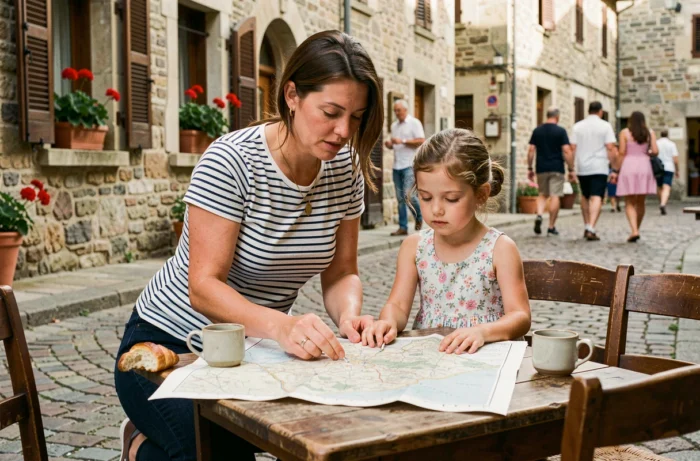
Destinations in France and Europe: balancing short travel and change of scenery
The choice of a family destination relies on a rarely articulated compromise: each additional hour of travel reduces the actual vacation time with young children. A weekend in France with a two-hour journey leaves almost two full days of activities. The same weekend with a four-hour flight, plus transfers, often boils down to just one usable day.
Traveling with family in France: nature and mountains
Nature and mountain stays in France offer a time-to-travel/change-of-scenery ratio that is hard to beat for families residing in the Hexagon. Outdoor activities (suitable hiking, skiing in season, swimming in lakes) do not require extensive logistical preparation.
- Mountain destinations allow for a combination of physical activities for parents and sensory discoveries for children, without time zone differences or administrative formalities
- Accommodations with kitchenettes, common in resorts and holiday villages, reduce meal budgets and simplify managing the dietary needs of the little ones
- A train journey rather than a flight avoids the issue of cabin baggage and assigned seating, while offering more freedom of movement for children during the trip
Destinations in Europe with children: what justifies the flight
For trips in Europe requiring a flight, the passenger rights reform will change the game regarding the actual budget. Until its implementation, comparing the total price (flight + surcharges + transfers + accommodation) with that of a road trip in France remains the most reliable reflex.
Southern European countries remain among the most suitable for families: mild climate over a long season, developed family-friendly tourist infrastructure, and no time zone differences. In contrast, more distant destinations in Europe (Scandinavia, Eastern Europe) imply longer flights and sometimes higher living costs, which alters the equation for a short stay.

Baggage and logistics: what families overestimate and underestimate
Most family travel guides recommend “traveling light.” The advice is sound, but rarely quantified. One cabin bag per adult covers the needs for a weekend if clothes are chosen to be layered and reused.
What families often underestimate, however, is the logistical weight of meals and snacks. With young children, planning a sufficient stock of food to cover transport delays or unexpected restaurant closures avoids situations of disproportionate stress.
- A compact cooler bag is a better alternative to a meal at an airport restaurant, which is often expensive and not child-friendly
- Basic medications (antipyretics, band-aids, saline solution) take up little space but their absence while traveling creates immediate stress
- Travel activities (notebooks, crayons, small card games) weigh less than a tablet with its charger and keep children occupied without relying on a battery
The question of a baby carrier also deserves consideration. For children under three years old, a physiological baby carrier replaces a stroller and car seat on short trips, freeing hands and eliminating a bulky piece of luggage.
Booking family flights: pricing traps to check
As long as the European reform is not applicable, families must manually check if the ticket price includes the possibility of sitting together. Some airlines assign random seats by default and then charge for grouping.
The text adopted by the European Parliament also stipulates that baggage fees must be displayed from the start of the booking process. Today, several comparison platforms do not include these fees in the price sorting, which skews the ranking of offers for families traveling with multiple bags.
Comparing two or three different booking platforms for the same itinerary, systematically adding baggage and seating options before confirming, remains the most reliable method to assess the real cost of a family trip with children. The forthcoming regulatory transparency will simplify this step, but it is not yet in place.