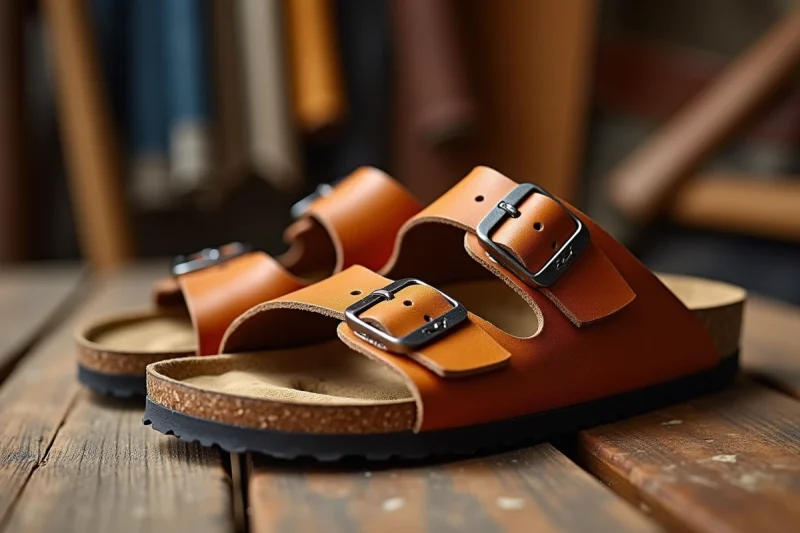
A pair of Birkenstock Arizona sandals costs significantly more today than it did a few years ago. The German brand, originally known for making orthopedic sandals, has prices that surprise a growing portion of its clientele. Between a premiumization strategy, rising production costs, and a repositioning towards accessible luxury, the reasons for this price inflation deserve factual examination.
Customs duties and sourcing costs: the factor buyers don’t see
The rise in Birkenstock prices is not solely a marketing choice. The latest financial publications from the group highlight a structural factor: the increase in costs related to new tariff barriers. Birkenstock has publicly expressed concern about the impact of customs duties on its sourcing costs, according to Zonebourse (2026).
Production remains mostly located in Germany, but raw materials (cork, leather, latex) move through international supply chains. Each new customs tax affects the final price. For a brand that refuses to relocate its manufacturing, these additional costs cannot be absorbed without a price adjustment.
Many consumers are trying to understand why Birkenstocks are so expensive, and this customs pressure constitutes a significant part of the answer, far beyond just brand image.

Birkenstock’s premiumization strategy: how high can the price go
Since L Catterton (a fund backed by LVMH) entered its capital, Birkenstock has accelerated a shift towards the premium segment. The IPO on Wall Street in the fall of 2023 formalized this ambition: transforming an orthopedic sandal into an accessible luxury product.
Collaborations with brands like Dior and Manolo Blahnik have repositioned the brand within the realm of quiet luxury. This positioning justifies, from the company’s perspective, regular price increases. The logic is well-known in the luxury industry: a high price enhances the perception of value.
The risk of commoditization of the premium model
This mechanism has its limits. Luxury Tribune noted in May 2026 that Birkenstock found itself “in the deadlock of accessible luxury.” The problem is twofold:
- The core product (molded cork sole, adjustable strap) remains functionally identical to models from ten years ago, making the price increase harder to justify in the eyes of the regular consumer.
- Prestigious collaborations create a temporary halo effect, but do not change the perception of the standard product sold in stores.
- The proliferation of premium references dilutes rarity, a pillar of the luxury positioning the brand seeks to achieve.
The available data does not allow for a conclusion on whether this strategy will reach a price ceiling in the short term. However, recent stock market signals suggest that investors are starting to have doubts.
Birkenstock stock price: what the market reveals about sandal prices
Birkenstock’s stock has fallen to its lowest level since 2023, with a market capitalization down about 38% below its IPO level of $9.3 billion. Despite a quarterly revenue increase of 8%, amounting to €618.3 million, the market deemed these results disappointing.
Piper Sandler has lowered its price target due to the impact of geopolitical tensions on sales. At the same time, Birkenstock announced an accelerated share buyback program of $250 million, a classic signal to support the stock price but which raises questions about resource allocation.
The disconnect between stock valuation and consumer price
The link between stock price and retail price is not direct, but it exists. A publicly traded company that promises premium growth to its shareholders cannot lower its prices. Investor pressure pushes to maintain or increase prices, even when demand weakens.
The group finds itself in a delicate position: satisfying Wall Street requires defending margins, while consumers perceive a growing gap between the price paid and the value received.
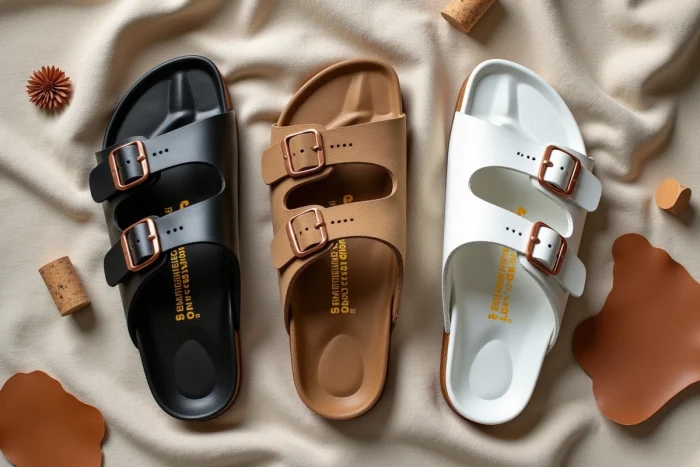
Birkenstock prices and consumer perception: the breaking point
On specialized forums, particularly Reddit (r/Birkenstocks), discussions around prices have become recurrent. Threads like “When did Birkenstocks get so expensive?” or “The prices are becoming insane” reflect a sentiment of disconnection between pricing and perceived value.
This phenomenon is not trivial for a brand whose historical customer base primarily sought comfort and durability, not prestige. The classic Birkenstock sandal has long been a utilitarian purchase, recommended by podiatrists. The shift from a health product to a fashion product has changed the target clientele, but not the product itself.
Field feedback diverges on this point: some buyers accept the price as a guarantee of German quality and durability, while others believe the brand is exploiting a fashion trend without tangible product improvement. The secondary market, where common models sometimes resell above the new price, adds a layer of complexity to this interpretation.
The pricing trajectory of Birkenstock results from a confluence of factors: rising logistical costs, a premiumization strategy backed by LVMH, stock market pressure on margins, and repositioning towards accessible luxury. Each of these elements taken in isolation seems rational. Their combination produces a price that the historical consumer base is increasingly struggling to absorb, without the brand showing any signs of inflection so far.