
Estimating a blood alcohol level of 2 g/L through calculation provides an order of magnitude, not a diagnosis. The Widmark formula, used by most online simulators, is based on the volume of alcohol consumed, body weight, and a diffusion coefficient that varies by gender.
At this level of concentration in the blood, the gap between the theoretical estimate and the reality measured by a certified breathalyzer or a blood test can be significant. Understanding how this calculation works, what it does not say, and what to do when faced with a person visibly in danger: these are the three areas that this article details.
Widmark Formula and Variables in Blood Alcohol Calculation
The reference formula for estimating blood alcohol content is written as: T = (V x t x 0.8) / (Cd x m). V represents the volume of beverage in milliliters, t the alcohol content of the beverage, 0.8 the density of alcohol, m the weight in kilograms, and Cd the diffusion coefficient.
This diffusion coefficient is set at 0.7 for men and 0.6 for women. The difference between the two values explains that with the same consumption, a woman reaches a higher blood alcohol level than a man of the same weight.
| Variable | Description | Typical Value |
|---|---|---|
| V | Volume of beverage (mL) | Variable depending on the container |
| t | Alcohol content of the beverage | 5% (beer), 12% (wine), 40% (spirits) |
| 0.8 | Density of ethanol | Constant |
| Cd | Diffusion coefficient | 0.7 (men) / 0.6 (women) |
| m | Body weight (kg) | Variable |
The concept of a standard drink simplifies reasoning. Each standard drink, whether it is a half-pint of beer, a glass of wine, or a shot of spirits served in a bar, contains approximately the same amount of pure alcohol. Before calculating 2 grams of alcohol in the blood, it is therefore necessary to convert each consumption into standard drinks; otherwise, the estimate is not reliable.
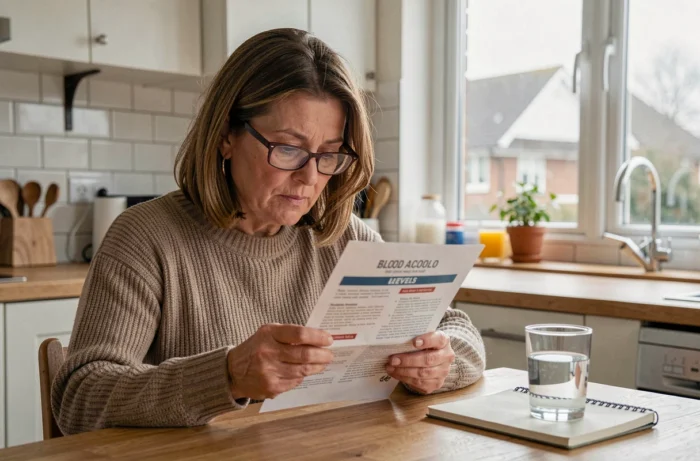
Discrepancy Between Theoretical Estimate and Actual Measurement at 2 g/L
An online simulator applies the Widmark formula linearly. It does not take into account the speed of ingestion, stomach contents, or individual metabolic variability. Two people of the same sex and weight, having consumed the same amount, can display very different actual levels.
The reference measurement remains the certified breathalyzer or blood analysis. A personal calculator does not constitute proof and does not allow one to decide if they can drive again.
Another frequent source of confusion: the unit of measurement used. Blood alcohol content is expressed in grams per liter of blood (g/L) or in milligrams per liter of exhaled air (mg/L). The legal threshold of 0.5 g/L corresponds to 0.25 mg/L of exhaled air. Comparing a value in one unit to a threshold expressed in the other completely distorts the interpretation of the result.
Factors Ignored by the Formula
- The use of medications, which can alter the hepatic metabolism of alcohol and amplify its effects at the same dose
- The state of fatigue or dehydration, which worsens symptoms without altering the theoretical calculation
- The speed of ingestion: drinking the same amount in one hour or four hours does not produce the same peak blood alcohol level, even if the total absorbed is identical
- Individual differences in liver function, which make any estimation by formula approximate
Recognizing an Emergency at 2 g/L: Act Before Calculating
When a person shows signs consistent with a blood alcohol level around 2 g/L, the reflex to calculate is counterproductive. The priority is clinical, not arithmetic.
A person who cannot be awakened, is unconscious, or is breathing abnormally requires an immediate call to 15 or 112. The risk of alcoholic coma exists at this level of intoxication, and the boundary between severe intoxication and vital distress is not always visible to untrained bystanders.
Warning Signs That Justify an Emergency Call
- Loss of consciousness or inability to keep the person awake despite stimulation
- Slow, irregular, or noisy breathing (fewer than one breath every four to five seconds)
- Cold, clammy skin, or bluish discoloration of the lips
- Vomiting in a semi-conscious person or one lying on their back (risk of inhalation)
While waiting for help, placing the person in the recovery position reduces the risk of choking. Never attempt to make them vomit, do not give them coffee or a cold shower: none of these practices speed up the elimination of alcohol.
Elimination of Alcohol: Why the Calculation of Time is Misleading
The body eliminates alcohol at a rate that varies from person to person. Simulators often provide an hourly estimate, but this average value masks real discrepancies that can be very wide.
Feeling better after sleeping does not prove that blood alcohol level has returned to zero. Sleep does not alter the rate of hepatic elimination. A person who falls asleep with a high level may wake up still above the legal threshold without being aware of it.
For a driver, the only reliable check remains the chemical or electronic breathalyzer, used at the right time. During the probationary period, the threshold drops to 0.2 g/L, which means zero drinks in practice, eliminating any margin for estimation.
The calculation of blood alcohol content provides a useful reference for understanding the relationship between consumption and blood level. At 2 g/L, this reference reaches its limits: the margin of error of the formula, individual variability, and the potential severity of the situation make the result of a simulator secondary to the direct observation of the person and, if necessary, the intervention of emergency services.