
The hybrid strategy has become the norm for operating an online product delivery service. Combining acquisition platforms and controlled delivery channels (local partner or own fleet) allows for margin control without sacrificing visibility. Here we detail the technical trade-offs that make the difference between a logistics flow that is imposed and an optimized sales channel.
Carrier arbitration: price, tracking, and customer service responsiveness
Comparing carriers solely on price per kilo is a framing error. Delivery optimization relies on a structural trade-off between price, tracking quality, and ease of contact in case of an incident. A cheaper carrier whose customer service responds within 72 hours ends up costing more, in returns and dissatisfaction, than a provider slightly above market rates with responsive support.
Turnkey solutions (like Amazon Shipping) now allow for the comparison of La Poste, Chronopost, DHL, or UPS from a single interface, including for return management and integration with online stores. We recommend testing at least two carriers in parallel over a month before finalizing an annual contract.
Before configuring your shipments, this guide on how to use www labonne livraison fr outlines the configuration steps on the platform side, from choosing the time slot to payment validation.
Three criteria to systematically evaluate during a carrier benchmark:
- The actual delivery speed (measured on your own packages, not on the announced timelines) compared to the price charged per weight bracket.
- The granularity of tracking: some providers only update the status at two stages (shipped / delivered), while others offer five to seven intermediate scan points.
- The complaint channel accessible to the final recipient, as it is your customer who will experience a delay, not you.
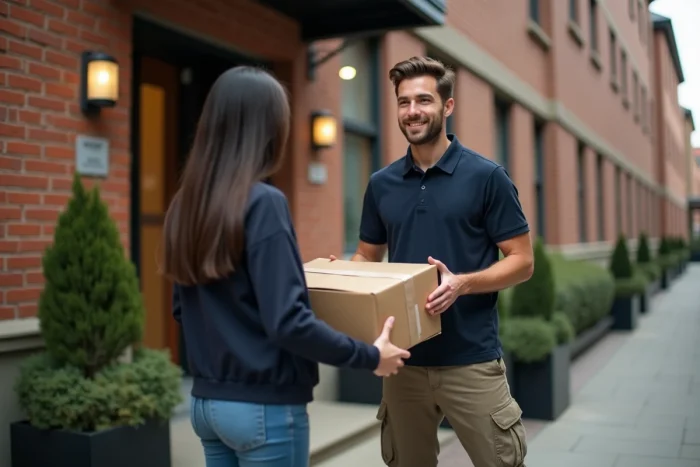
Online delivery modes: home, pickup points, and automated lockers
The choice of delivery mode influences the conversion rate at checkout. Offering at least three options (home delivery, pickup point, locker) covers the vast majority of use cases without overly complicating logistics.
Home delivery and scheduled time slots
Home delivery remains the preferred mode for bulky or fragile packages. The technical lever lies in scheduling time slots: a two-hour slot significantly reduces the failure rate of the first delivery attempt compared to an “all-day” window.
The additional cost of this service is often absorbable if reserved for baskets above a certain threshold. Clearly displaying the price of each option at the time of selection prevents cart abandonment due to late-discovered fees.
Pickup points and lockers in France
The networks of pickup points (Mondial Relay, Relais Colis, Shop2Shop) offer a dense coverage in France, with shipping costs lower than home delivery. Automated lockers, still a minority, are gaining ground in densely populated urban areas. Picking up from a locker removes time constraints and limits disputes related to packages left with a neighbor.
Return management and post-purchase order tracking
A poorly designed return process turns every product dissatisfaction into overall customer dissatisfaction. We observe that most merchants underestimate the impact of returns on customer loyalty.
The return process should be as easy to initiate as the initial order. Technically, this involves generating a prepaid label from the customer area, with reverse tracking (the return package benefits from the same number of scan points as the initial shipment).
On the post-purchase tracking side, personalizing notifications via email or SMS goes far beyond a simple “your package is on the way.” Integrating the product name, estimated date, and a direct tracking link in each message reduces the volume of calls to customer service. Multi-carrier platforms centralize these notifications regardless of the provider used for shipping.
Hybrid strategy: delivery platforms and own channel
For merchants who also sell food or fresh products, the temptation to entrust everything to Uber Eats or Deliveroo is countered by the weight of commissions. The most profitable strategy combines a platform for acquisition and in-house delivery for customer retention.
In practice, the platform serves as a showcase: it captures customers who do not know you. Once the first order is placed, a promotional code slipped into the package redirects to your own online ordering channel, where you control the margin and customer relationship.
This approach assumes having a reliable logistics solution in-house or through a local partner. Route planning tools allow for grouping deliveries by geographic area and reducing last-mile costs, even with a small fleet.
Indicators to monitor for managing the direct channel
- The repurchase rate outside the platform after first contact via Uber Eats or Deliveroo, which measures the effectiveness of your redirect strategy.
- The average delivery cost per order in-house, compared to the commission charged by the platform on an equivalent basket.
- The average time between order validation and actual delivery to the customer, as a slower direct channel than the platform will not hold.
The trade-off between outsourced delivery service and controlled logistics has no universal answer. It depends on the order volume, catchment area, and type of products shipped. What remains constant is the need to measure each flow separately and adjust the distribution every quarter based on actual performance data.